

Can a Sand Media Filter be used for removing algae in water?
Hey there! I'm a supplier of Sand Media Filters, and I often get asked if these filters can be used to remove algae from water. Well, let's dive right into it and find out.
First off, what exactly is algae? Algae are simple, plant - like organisms that can grow in water. They come in various forms, from the microscopic single - celled types to the large, multicellular seaweeds. In water systems, algae can be a real nuisance. They can make the water look green and murky, produce unpleasant odors, and even clog pipes and other equipment.
Now, let's talk about Sand Media Filters. A Sand Media Filter, as the name suggests, uses sand as the primary filtering medium. Water passes through the sand bed, and the sand traps particles and impurities in the water. The way it works is based on physical filtration. As water moves through the small spaces between the sand grains, larger particles get stuck, and cleaner water comes out the other end.
So, can a Sand Media Filter remove algae? The short answer is yes, to some extent. If the algae are in the form of large clumps or colonies, a Sand Media Filter can definitely trap them. When these big algae clusters flow into the filter, they can't pass through the sand bed and are left behind. This is similar to how the filter traps other large particles like dirt and debris.
But here's the catch. Not all algae are big clumps. A lot of algae exist as single - celled organisms or small aggregates that are extremely tiny. These microscopic algae can easily slip through the pores in the sand. The sand in a typical Sand Media Filter has pore sizes that are large enough for these small algae to pass through without getting trapped.
However, we can take some steps to make the Sand Media Filter more effective at removing algae. One option is to use a coagulant. A coagulant is a chemical that can cause the small algae particles to stick together and form larger clumps. Once they are in larger clumps, the Sand Media Filter can then trap them more easily. For example, polyaluminum chloride (PAC) is a commonly used coagulant in water treatment. When added to the water before it enters the filter, it can help in aggregating the small algae.
Another factor to consider is the flow rate of the water through the filter. If the water is flowing too fast, even large algae clumps might not get properly trapped. The water needs to have enough time to interact with the sand bed so that the algae can be caught. So, it's important to set the flow rate at an appropriate level for the size and capacity of the Sand Media Filter.
Now, let's compare Sand Media Filters with other types of filters when it comes to algae removal. The Activated Carbon Filter is another popular option. Activated carbon works mainly by adsorption, which means it attracts and holds onto certain substances on its surface. While it can remove some organic compounds associated with algae, it's not as effective as a Sand Media Filter in physically trapping the algae themselves.
On the other hand, a Water Softener is designed to remove minerals like calcium and magnesium from water to make it "soft." It doesn't have any direct mechanism for removing algae. So, if your main goal is to get rid of algae, a Sand Media Filter is a better choice compared to a water softener.
In a water treatment system, a Sand Media Filter can be part of a multi - stage process. It can be used as a pre - filter to remove the larger algae clumps and other big particles. After that, other more specialized filters or treatment methods can be used to deal with the remaining microscopic algae. For example, ultraviolet (UV) light treatment can be used to kill the single - celled algae that passed through the Sand Media Filter.
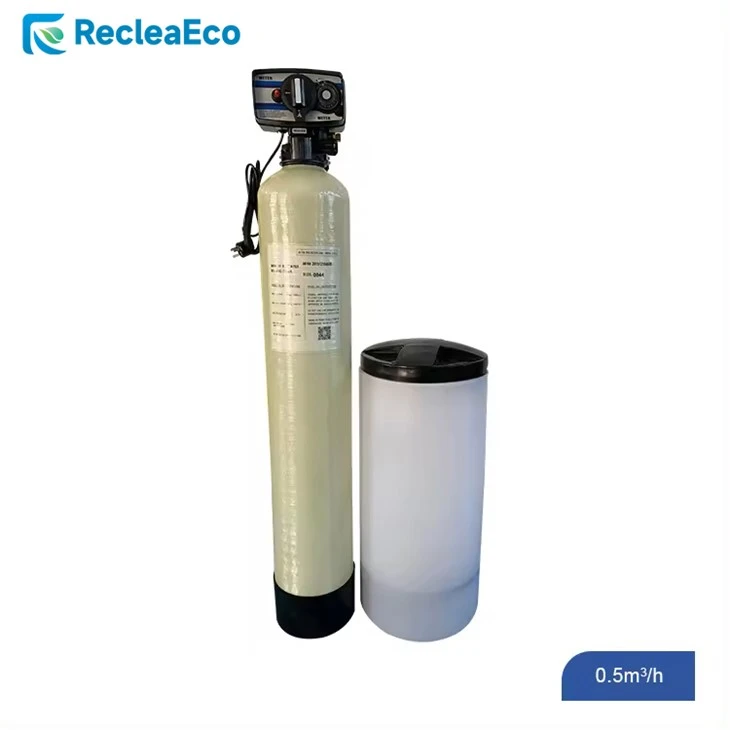

If you're thinking about using a Sand Media Filter for algae removal, there are a few things you need to keep in mind. First, you need to choose the right type of sand. The sand should have the appropriate grain size and uniformity. Fine - grained sand can trap smaller particles but might also clog more easily, while coarse - grained sand allows for faster water flow but might not trap small particles as well.
You also need to maintain the filter properly. Regular backwashing is essential. Backwashing involves reversing the flow of water through the filter to remove the trapped particles, including the algae. If you don't backwash the filter regularly, it will get clogged, and its efficiency will decrease.
In conclusion, a Sand Media Filter can play a role in removing algae from water, especially the larger clumps. But it's not a one - size - fits - all solution for all types of algae. By using coagulants, controlling the flow rate, and combining it with other treatment methods, you can make it more effective.
If you're interested in learning more about our Sand Media Filters and how they can be used for algae removal in your water system, feel free to reach out. We're here to help you find the best solution for your specific needs. Whether you have a small home water system or a large industrial one, we can provide the right Sand Media Filter and offer advice on how to use it effectively.
References
- AWWA (American Water Works Association). Water Treatment Plant Design. McGraw - Hill.
- Crittenden, J. C., Trussell, R. R., Hand, D. W., Howe, K. J., & Tchobanoglous, G. (2012). Water Treatment: Principles and Design. Wiley.