

Yo, what's up everyone! I'm a supplier of submersible thrusters, and today I wanna chat about the effects of cavitation on these bad boys. Cavitation is one of those things that can really mess with your submersible thruster's performance, and it's super important to understand what it is and how it impacts your equipment.
So, first off, what the heck is cavitation? Well, cavitation happens when the pressure of a liquid drops below its vapor pressure, causing vapor bubbles to form. These bubbles then collapse when they move into an area of higher pressure, creating shockwaves. In the context of a submersible thruster, this usually occurs around the propeller blades.
Let's start with the negative effects of cavitation on a submersible thruster. One of the most obvious issues is reduced efficiency. When cavitation occurs, those collapsing bubbles disrupt the smooth flow of water around the propeller. This means the propeller has to work harder to generate the same amount of thrust. It's like trying to run through a pool full of bubbles instead of clear water. As a result, your thruster consumes more power to achieve the desired speed and performance. And let's be real, nobody wants higher energy bills, right?
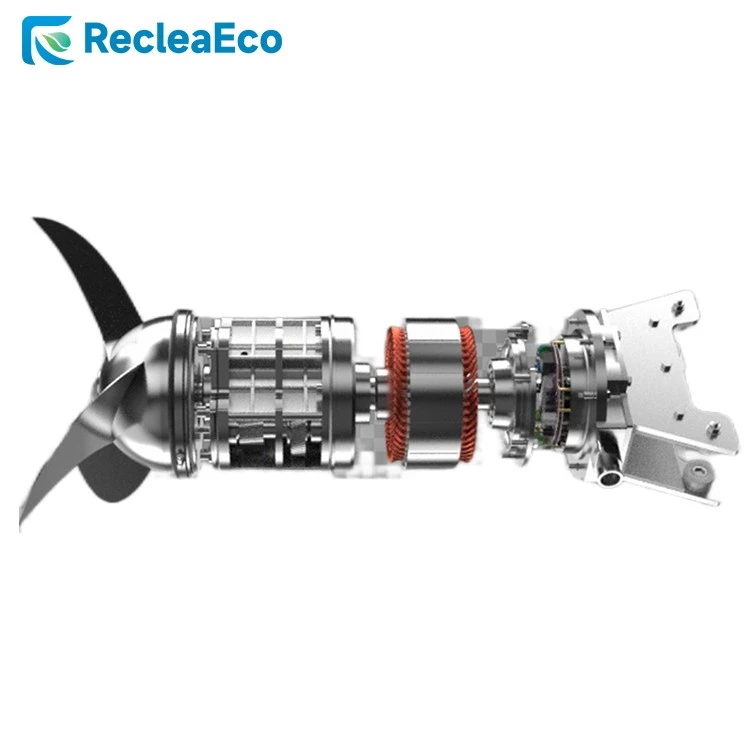

Another big problem is wear and tear on the propeller. The shockwaves created by the collapsing bubbles are no joke. They can cause pitting and erosion on the surface of the propeller blades. Over time, this damage can get pretty severe, weakening the blades and potentially leading to structural failure. If the propeller blades are damaged, the thruster won't be able to function properly, and you'll end up having to replace the propeller or even the whole thruster. That's a costly headache that you definitely want to avoid.
Noise and vibration are also side - effects of cavitation. The collapsing bubbles make a lot of noise, kind of like a popping or crackling sound. This can be a real nuisance, especially in applications where a quiet operation is required, like in research submarines or underwater observation systems. Moreover, the vibrations caused by cavitation can transfer to the rest of the thruster and the vessel it's attached to. These vibrations can damage other components of the system and make the whole setup less stable.
But it's not all doom and gloom. There are also some potential positive effects of cavitation in certain situations. For example, in some industrial applications, the shockwaves from cavitation can be used to break up particles or agitate the surrounding fluid. This can be useful in processes like mixing or cleaning. However, in the context of a submersible thruster, we're usually more concerned with minimizing cavitation rather than using it for these purposes.
Now, as a submersible thruster supplier, I know how important it is to prevent cavitation. There are several ways to do this. One of the most effective methods is to design the propeller properly. By using the right blade shape, pitch, and material, we can reduce the likelihood of cavitation occurring. We also need to make sure that the thruster is operating within its recommended speed and load range. Running the thruster at too high a speed or under excessive load can increase the chances of cavitation.
If you're in the market for a submersible thruster, you might also be interested in some related products. Check out our Ultra - Energy - Saving Submersible Mixer, which is designed to be energy - efficient and reliable. We also have a Vertical Agitator that can be used in a variety of applications, and a Hyperboloid Mixer that offers unique mixing capabilities.
In conclusion, cavitation can have both negative and positive effects on a submersible thruster, but in most cases, we want to keep it under control. As a supplier, I'm always looking for ways to improve the performance and durability of our thrusters by minimizing cavitation. If you're thinking about purchasing a submersible thruster or have any questions about cavitation and how it affects your equipment, don't hesitate to reach out. We're here to help you make the best choice for your needs. Let's have a chat about your requirements and see how we can work together to get you the right submersible thruster.
References
- "Fluid Mechanics" by Frank M. White. This book provides in - depth knowledge about fluid dynamics, including the principles of cavitation.
- "Marine Propellers and Propulsion" by John Carlton. It offers detailed information on the design and performance of marine propellers, which is highly relevant to submersible thrusters.