

What is the flow rate of a submersible mixer?
As a supplier of submersible mixers, I often get asked about the flow rate of these essential pieces of equipment. Understanding the flow rate of a submersible mixer is crucial for ensuring its proper application in various industries, especially in wastewater treatment, chemical processing, and aquaculture.
Understanding Flow Rate
The flow rate of a submersible mixer refers to the volume of fluid that the mixer can move per unit of time. It is typically measured in cubic meters per hour (m³/h) or gallons per minute (GPM). The flow rate is a key parameter that determines the mixer's ability to create effective mixing and circulation in a liquid medium.
A higher flow rate means that the mixer can move more fluid in a given time, which is beneficial for large - scale applications or situations where rapid mixing is required. On the other hand, a lower flow rate may be sufficient for smaller tanks or applications where gentle mixing is needed.
Factors Affecting the Flow Rate
Several factors can influence the flow rate of a submersible mixer:
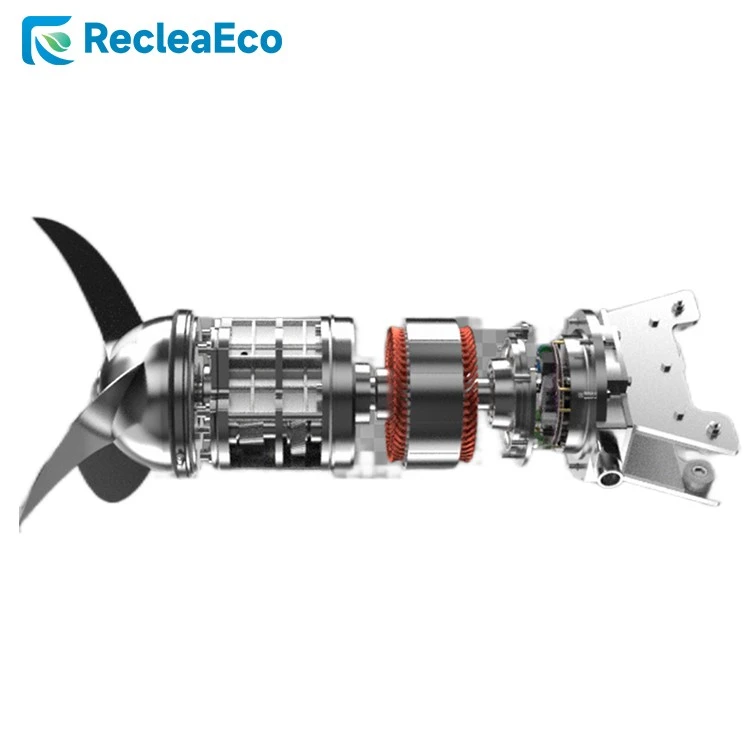
- Impeller Design: The shape, size, and number of blades on the impeller play a significant role in determining the flow rate. A well - designed impeller can efficiently transfer energy from the motor to the fluid, resulting in a higher flow rate. For example, a large - diameter impeller with a proper blade pitch can generate more flow compared to a smaller one.
- Motor Power: The power of the motor driving the mixer is directly related to the flow rate. A more powerful motor can spin the impeller at a higher speed, which in turn increases the flow rate. However, it's important to note that increasing the motor power also increases energy consumption.
- Fluid Properties: The viscosity, density, and temperature of the fluid being mixed can affect the flow rate. Viscous fluids require more energy to move, so the flow rate may be lower compared to less viscous fluids. Similarly, denser fluids can also pose more resistance to the impeller, reducing the flow rate.
- Tank Geometry: The shape and size of the tank where the mixer is installed can impact the flow rate. A tank with a complex shape or internal obstructions may disrupt the flow pattern, reducing the overall flow rate. In contrast, a simple cylindrical tank with a smooth interior can promote better flow and higher flow rates.
Calculating the Required Flow Rate
To determine the appropriate flow rate for a specific application, several factors need to be considered:
- Tank Volume: The larger the tank volume, the higher the flow rate required to achieve proper mixing. A general rule of thumb is that the mixer should be able to circulate the entire tank volume at least once every hour for effective mixing.
- Mixing Objectives: Different applications have different mixing requirements. For example, in wastewater treatment, the goal may be to suspend solids and promote chemical reactions. In this case, a higher flow rate may be needed to ensure thorough mixing. In aquaculture, the objective may be to maintain oxygen levels and prevent sedimentation, which may require a more moderate flow rate.
- Fluid Characteristics: As mentioned earlier, the properties of the fluid, such as viscosity and density, should be taken into account when calculating the required flow rate.
Here is a simple formula to estimate the required flow rate (Q) based on the tank volume (V) and the desired turnover time (t):
Q = V / t
For example, if you have a tank with a volume of 100 m³ and you want to circulate the entire volume every 2 hours, the required flow rate would be:
Q = 100 m³ / 2 h = 50 m³/h
Our Submersible Mixers and Their Flow Rates
At our company, we offer a wide range of submersible mixers with different flow rates to meet the diverse needs of our customers. Our Ultra - Energy - Saving Submersible Mixer is designed to provide high - efficiency mixing with a focus on energy conservation. It is available in various models with flow rates ranging from 10 m³/h to 500 m³/h, making it suitable for both small - scale and large - scale applications.
Our Submersible Reflux Pump is another popular product that combines the functions of a mixer and a pump. It has a unique design that allows it to generate a high flow rate while maintaining excellent mixing performance. The flow rates of our submersible reflux pumps can reach up to 1000 m³/h, making them ideal for applications such as wastewater treatment plants and industrial processes.
In addition, we also offer Vertical Agitator which is suitable for applications where vertical mixing is required. These agitators have a compact design and can provide a stable flow rate for effective mixing in tanks of different sizes.

Importance of Choosing the Right Flow Rate
Selecting the appropriate flow rate for your submersible mixer is crucial for several reasons:
- Efficient Mixing: A correct flow rate ensures that the fluid in the tank is thoroughly mixed, which is essential for achieving the desired process results. For example, in a chemical reaction tank, proper mixing can improve the reaction efficiency and product quality.
- Energy Efficiency: Using a mixer with an appropriate flow rate can help reduce energy consumption. An oversized mixer with a high flow rate may consume more energy than necessary, while an undersized mixer may not provide sufficient mixing, leading to inefficiencies.
- Equipment Longevity: A mixer operating at the correct flow rate is less likely to experience excessive wear and tear. This can extend the lifespan of the equipment and reduce maintenance costs.
Contact Us for Your Submersible Mixer Needs
If you are looking for a submersible mixer with the right flow rate for your specific application, we are here to help. Our team of experts can provide you with professional advice and guidance on selecting the most suitable mixer for your needs. Whether you are in the wastewater treatment industry, chemical processing, or aquaculture, we have the right solution for you.
Don't hesitate to contact us to discuss your requirements and start the procurement process. We are committed to providing high - quality products and excellent customer service to ensure your satisfaction.
References
- "Mixing Technology Handbook" by Paul E. Myers.
- "Wastewater Treatment Processes" by Metcalf & Eddy.
- Technical literature from various submersible mixer manufacturers.