

Submersible thrusters are essential equipment in various underwater applications, including wastewater treatment, aquaculture, and marine research. As a leading supplier of Submersible Thruster, we understand the importance of choosing the right type of thruster for your specific needs. In this blog post, we will explore the differences between different types of submersible thrusters, helping you make an informed decision.
Axial Flow Submersible Thrusters
Axial flow submersible thrusters are the most common type of submersible thrusters. They work by creating a flow of water parallel to the axis of the propeller. These thrusters are known for their high flow rates and relatively low head (pressure) capabilities.
The design of axial flow thrusters typically consists of a propeller mounted on a shaft, which is driven by an electric motor. The propeller blades are designed to push water in a straight line, creating a continuous flow. This makes them ideal for applications where large volumes of water need to be moved, such as in wastewater treatment plants for mixing and circulation.
One of the main advantages of axial flow submersible thrusters is their energy efficiency. They can move a large amount of water with relatively low power consumption, which can result in significant cost savings over time. Additionally, their simple design makes them easy to install and maintain.
However, axial flow thrusters have some limitations. They are not suitable for applications that require high pressure, as they have a relatively low head capacity. In addition, they may not be as effective in creating strong mixing in areas with complex geometries or high viscosity fluids.
Mixed Flow Submersible Thrusters
Mixed flow submersible thrusters combine the characteristics of axial flow and radial flow thrusters. They create a flow of water that is both parallel and perpendicular to the axis of the propeller. This results in a more complex flow pattern, which can provide a better balance between flow rate and head.
The propeller design of mixed flow thrusters is more complex than that of axial flow thrusters. The blades are shaped to generate both axial and radial forces, allowing them to move water more efficiently in a wider range of conditions. Mixed flow thrusters are often used in applications where a moderate flow rate and a relatively high head are required, such as in aquaculture ponds for water circulation and aeration.
One of the key advantages of mixed flow submersible thrusters is their versatility. They can be used in a variety of applications, from small-scale aquaculture systems to large industrial wastewater treatment plants. They also tend to have a higher efficiency than axial flow thrusters in applications where a combination of flow rate and head is needed.
However, mixed flow thrusters are generally more expensive than axial flow thrusters due to their more complex design. They also require more precise installation and maintenance to ensure optimal performance.
Radial Flow Submersible Thrusters
Radial flow submersible thrusters create a flow of water that is perpendicular to the axis of the propeller. They are designed to generate high pressure and are typically used in applications where a relatively low flow rate but high head is required.

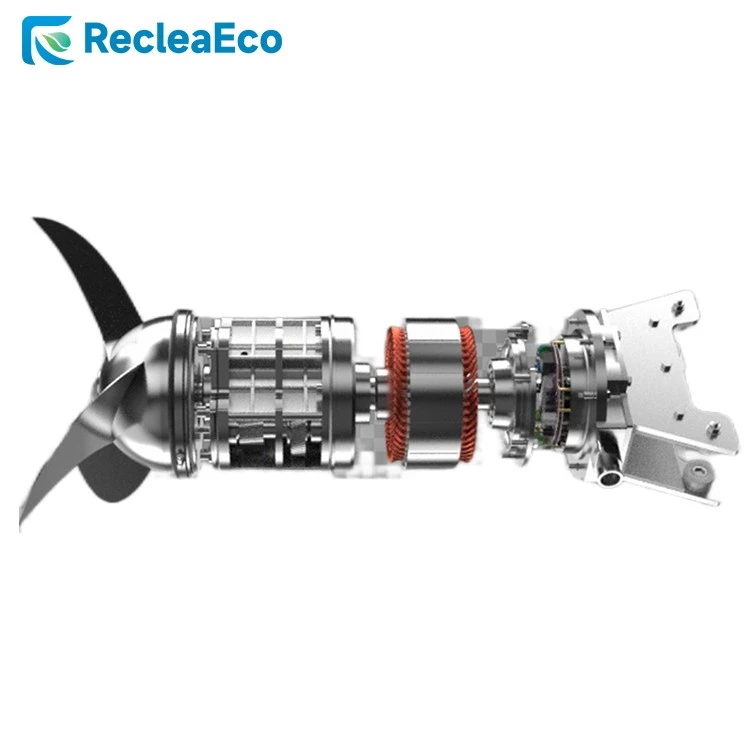
The propeller of a radial flow thruster is designed with curved blades that push water outwards in a radial direction. This design allows the thruster to generate a high pressure, making it suitable for applications such as pumping water against a high resistance or for creating a strong jet of water.
Radial flow submersible thrusters are commonly used in applications such as deep-sea exploration, where high pressure is needed to overcome the hydrostatic pressure of the water column. They are also used in some industrial processes, such as in the injection of chemicals into a pipeline, where a high-pressure flow is required.
One of the main advantages of radial flow submersible thrusters is their ability to generate high pressure. They can operate effectively in applications where other types of thrusters may not be able to provide sufficient power. However, they are generally less energy-efficient than axial or mixed flow thrusters, as they require more power to generate the same flow rate.
Comparison of Different Types of Submersible Thrusters
To better understand the differences between axial, mixed, and radial flow submersible thrusters, let's compare them in terms of several key factors:
Flow Rate
Axial flow submersible thrusters typically have the highest flow rates among the three types. They are designed to move large volumes of water quickly, making them suitable for applications where rapid water circulation is required. Mixed flow thrusters have a moderate flow rate, while radial flow thrusters have the lowest flow rate.
Head (Pressure)
Radial flow submersible thrusters have the highest head capacity, followed by mixed flow thrusters. Axial flow thrusters have the lowest head capacity. This means that radial flow thrusters are best suited for applications that require high pressure, while axial flow thrusters are more suitable for applications where high flow rates are needed.
Energy Efficiency
Axial flow submersible thrusters are generally the most energy-efficient type, followed by mixed flow thrusters. Radial flow thrusters are the least energy-efficient, as they require more power to generate the same flow rate.
Cost
Axial flow submersible thrusters are usually the most cost-effective option, due to their simple design and widespread availability. Mixed flow thrusters are more expensive than axial flow thrusters, while radial flow thrusters are the most expensive, mainly because of their complex design and high-pressure capabilities.
Application Suitability
Axial flow thrusters are ideal for large-scale water circulation and mixing applications, such as in wastewater treatment plants and large aquaculture ponds. Mixed flow thrusters are suitable for a wide range of applications where a balance between flow rate and head is required. Radial flow thrusters are best used in applications that require high pressure, such as deep-sea exploration and industrial chemical injection.
Choosing the Right Submersible Thruster
When choosing a submersible thruster for your application, it is important to consider several factors, including the required flow rate, head, energy efficiency, and cost. Here are some steps to help you make the right decision:
- Determine your application requirements: Consider the specific needs of your application, such as the volume of water to be moved, the distance the water needs to be pumped, and the pressure required. This will help you determine the appropriate flow rate and head for your thruster.
- Evaluate energy efficiency: Look for a thruster that offers high energy efficiency to reduce operating costs over time. Axial flow thrusters are generally the most energy-efficient option for applications that require high flow rates, while mixed flow thrusters can provide a good balance between flow rate and energy efficiency.
- Consider the cost: Compare the upfront cost of different types of thrusters, as well as the long-term operating costs. While axial flow thrusters are usually the most cost-effective option, you may need to invest in a more expensive mixed or radial flow thruster if your application requires high pressure or specific performance characteristics.
- Consult with a professional: If you are unsure which type of submersible thruster is best for your application, consult with a professional engineer or a supplier with experience in underwater equipment. They can provide valuable advice and help you select the right thruster for your needs.
Other Related Products
In addition to submersible thrusters, we also offer a range of other related products, such as Vertical Agitator and Ultra-Energy-Saving Submersible Mixer. These products can be used in conjunction with submersible thrusters to improve the efficiency and performance of your underwater systems.
Vertical agitators are designed to provide strong mixing in tanks and basins. They can be used to prevent sedimentation, promote chemical reactions, and improve the overall quality of the water. Ultra-energy-saving submersible mixers are specifically designed to reduce energy consumption while providing effective mixing. They are ideal for applications where energy efficiency is a priority.
Contact Us for Procurement
If you are interested in purchasing submersible thrusters or any of our other products, we invite you to contact us for a detailed discussion. Our team of experts is ready to assist you in selecting the right equipment for your specific needs and providing you with competitive pricing and excellent customer service.
Whether you are a wastewater treatment plant operator, an aquaculture farmer, or a marine researcher, we have the solutions to meet your requirements. Don't hesitate to reach out to us and start the procurement process today.
References
- Smith, J. (2020). "Underwater Equipment Handbook." Elsevier.
- Johnson, R. (2019). "Advances in Submersible Thruster Technology." Journal of Marine Engineering.
- Brown, A. (2018). "Energy Efficiency in Submersible Equipment." International Journal of Energy Research.